
Find Hidden Cats- Spot it!
Playful BytesCasual
4.81.34K Reviews
- Version
- 1.2.0
- Installs
- 1.00M
- Age Rating
- Everyone
Screenshots
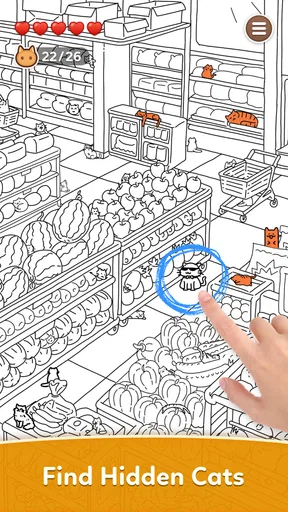
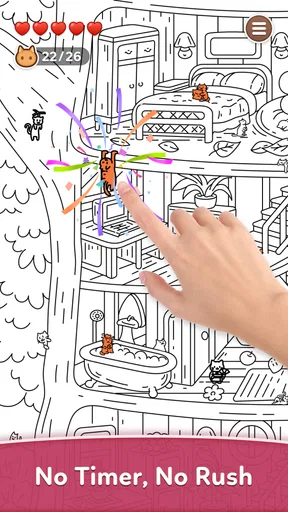

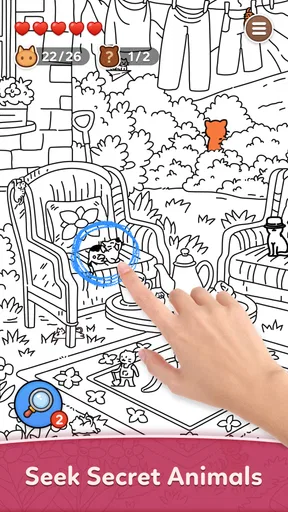

Our Review of Find Hidden Cats- Spot it!
 Analysis by Appyee
I approached Find Hidden Cats- Spot it! as the kind of casual game I could open for a few quiet minutes, rather than something demanding a long session or a complicated tutorial. Its whole appeal is easy to understand: look carefully, find the cats, and enjoy the small satisfaction of noticing what was hidden in plain sight. That simplicity is a strength, especially when I want a low-pressure distraction, but it also means the quality of the visual experience matters more than a large collection of systems or features.
Developed by Playful Bytes, this free game sits firmly in the casual category and is suitable for Everyone. It has reached over one million installs, with an average rating of 4.8 from around 9,400 ratings and roughly 1,300 written reviews. Those figures suggest that the straightforward hidden-object idea is connecting with a broad audience. The game was released on September 5, 2025, and version 1.2.0 requires Android 8.0 or later.
How clearly the game supports different players
I find the game’s clearest strength is how little it asks a new player to learn before joining in: the task is to scan a scene, notice a cat, and make a careful selection. That simplicity makes it easy to share with someone who rarely plays mobile games, while the visual focus gives the activity its own pace. The next section looks at how that straightforward idea can feel different depending on the screen, the setting, and the player’s comfort with close observation.
Readability and navigation come before the search itself
The most important part of a hidden-cat game is not a menu full of options; it is whether I can understand the scene quickly and keep track of what I am looking at. In this type of game, visual organization does a lot of the teaching. A player should be able to recognize the play area, understand where to search, and tell the difference between an actual cat and a distracting background detail without needing a long explanation.
That makes the basic concept approachable for people who do not usually play games. I would feel comfortable handing it to a friend who prefers simple interactions, because the objective is immediately familiar: scan the image and spot the animals. There is no need to learn a character build, remember a complicated control scheme, or understand a story before getting started. The short description, “Find Hidden Cats,” communicates the central activity accurately without turning it into a puzzle that needs decoding first.
For readability, I found that the best approach is to treat each picture like a visual map instead of staring at the center and hoping a cat appears. I move my attention in a slow pattern from one edge to the other, then check the corners and areas where colors or shapes blend together. This is more reliable than random tapping, and it also makes the game feel calmer. Players with attention difficulties may benefit from dividing the scene into small sections and taking a brief pause between them.
Navigation is similarly uncomplicated in spirit, which is useful for younger players and anyone who becomes frustrated by layered menus. Still, simplicity should not be confused with universal ease. A clean-looking scene can be difficult if the objects are visually similar, and a player who struggles to distinguish small shapes may need more time than someone with sharp close-up vision. The game’s central idea remains accessible, but the artwork itself determines how inclusive each search feels.
Useful habits for visual searching
One practical technique is to search by contrast rather than by object. Instead of asking, “Where is the cat?” I first look for a curve, a pair of eyes, a patch of fur, or an outline that breaks the surrounding pattern. This helps when a cat is partly concealed by the visual environment. It also reduces the tendency to repeatedly inspect the same obvious places.
Another helpful habit is to use a fixed sweep. I start at the top left, move across in a line, drop slightly, and return in the opposite direction. That approach is especially useful on a small phone screen because it limits unnecessary eye movement. If I jump around the image, I can easily miss a detail and then assume the game has failed to register something. A systematic scan gives me a better sense of whether I truly searched the whole scene.
I would also recommend holding the phone at a comfortable distance instead of bringing it very close to the face. That may sound obvious, but hidden-object games encourage intense concentration, and it is easy to tense up while hunting for the last cat. Short sessions, a brighter environment, and occasional breaks make the experience more comfortable without changing the game’s relaxed character.
Motor and sensory considerations
From a motor perspective, this is a much gentler proposition than a game based on fast reactions. Searching for a hidden cat does not require the repeated rapid swipes or precise movement that can make action games tiring. That makes it a reasonable choice for someone who prefers slower interaction or finds timed play stressful. The main physical demand is accurate tapping when I believe I have found something.
That final tap can still matter. On a compact phone, a small target may be harder to select than it looks, particularly for players with limited fine-motor control or anyone using the device one-handed. I found that using both hands, keeping the phone steady, and tapping the middle of the suspected object is more dependable than trying to play while walking or holding other items. A stylus could also make precise selection easier for some people, although that is a personal setup choice rather than a requirement of the game.
Sensory comfort is another part of the experience. Hidden-object play is visually focused, so players with low vision, color-perception differences, visual fatigue, or sensitivity to busy scenes may find some searches more demanding. I would not describe this as a game that removes visual barriers; it is a game built around looking closely. That distinction is important. The absence of fast action helps one group of players, while the reliance on small visual clues may exclude another.
For children, the Everyone rating makes the tone approachable, but supervision can still be sensible for younger players who become frustrated when they cannot find the final detail. I would encourage a child to describe where they have already searched rather than tapping everywhere. That turns the activity into a patient observation exercise and avoids the habit of treating the screen as something to hit repeatedly.
Playing in different everyday situations
The strongest use case is a short break when I want something more engaging than scrolling but less demanding than a full game. I can imagine playing it while waiting for an appointment, during a quiet commute when seated, or at home after finishing a task. Because the premise is easy to resume, it suits people who do not want to remember a complicated objective after putting the phone down.
It is also a good candidate for shared play. One person can hold the phone while another points out a suspicious shape, making the search collaborative rather than competitive. That works well with a child, a family member, or a friend who does not normally play mobile games. The simple premise gives everyone a common task immediately, and nobody needs to understand a large fictional world before joining in.
However, I would avoid using it in situations that require constant awareness of the surroundings. Searching carefully at a screen is not appropriate while walking, cycling, driving, or handling equipment. Even when seated in public, glare and movement can make small details harder to see. If I am tired, in a dim room, or dealing with a distracting environment, the game becomes less relaxing because I am forcing my eyes to work harder.
That situational point is easy to overlook. A game can be casual in design while still demanding concentrated visual attention. I get the best experience when I choose a stable place, set the screen at a comfortable angle, and give myself permission to stop after a short session. It is not a background activity in the way an audio app might be; I need to look at it to play properly.
Where it differs from familiar casual alternatives
Compared with match-three games, this title is less about planning chains, managing a board, or chasing a high score. Compared with word games, it does not ask me to recall vocabulary or construct answers. Its challenge comes from observation and patience. That makes it a better fit for someone who wants a visual scavenger hunt, but a weaker fit for anyone seeking strategy, progression systems, or a strong sense of competition.
It also differs from fast arcade games because mistakes are not the main source of excitement. The pleasure is in noticing. I would choose this over a reflex game when I want to slow down, especially after a busy day. On the other hand, if I am looking for a game that changes dramatically from session to session or rewards mastery of complex mechanics, a conventional puzzle or strategy title will probably offer more depth.
The cat theme gives the search a warmer personality than a generic object-finding exercise. That matters for younger players and animal lovers, but it does not transform the game into a story-driven experience. The appeal remains focused: inspect the scene and spot the cats. Anyone expecting character development, simulation, or a substantial narrative should adjust their expectations before downloading.
Remaining barriers and points of friction
The biggest limitation is inherent to the format: visual searching can become tiring. When the final cat is difficult to distinguish, the experience may shift from satisfying to irritating. Players with color-vision differences or reduced visual acuity may need a larger display, stronger ambient lighting, or help from another person. I would not recommend it as the only game for someone who needs text enlargement, audio guidance, or non-visual alternatives.
Screen size also changes the balance. A tablet could make careful inspection more comfortable, while a small phone may turn subtle details into a squinting exercise. If a player regularly uses device magnification or prefers large interface elements, the practical question is not whether the concept is simple, but whether the artwork remains comfortable to inspect on that particular screen.
There is a motor trade-off as well. Slow play is friendlier than rapid tapping, but the game still depends on selecting the correct spot. If a player has tremors or difficulty making a precise touch, the search may be enjoyable only when played with extra time and a stable grip. I would avoid judging success by speed and instead treat each scene as an observation task. That mindset reduces pressure, although it cannot remove the need for accurate interaction.
Another possible barrier is shared attention. A player who is easily distracted by nearby conversation, movement, or bright reflections may miss details that would be obvious in a quiet room. This is not a flaw unique to this title, but it is particularly relevant because the game’s challenge is subtle rather than energetic. A noisy setting can make it feel harder without the game itself changing.
For users who need a game to provide audio-led feedback, extensive customization, or a strong non-visual route through the content, I would look elsewhere. A word-based puzzle, audio game, or more adjustable casual title may be a better match. I appreciate that this game keeps its idea focused, but that focus means it cannot serve every access need equally well.
Who I would recommend it to
I would recommend this game to people who enjoy quiet visual puzzles, cat themes, and short sessions that can be picked up without preparation. It is especially suitable for casual players who do not want complicated rules, younger users playing with an adult nearby, and friends looking for a simple shared activity. The free price removes the usual commitment involved in trying a small mobile game, which makes experimentation easy.
I would be more cautious about recommending it to players who need constant novelty, competitive scoring, deep strategy, or a story to maintain interest. I would also suggest trying it on the intended device before committing emotionally to the format if small visual details are difficult for you. The game’s friendliness comes from its simplicity, but its central challenge can be demanding for anyone who finds close visual inspection uncomfortable.
When I play, I get the most from it by setting a modest goal: complete one search carefully, take a break, and return later if I still feel like looking. I avoid frantic tapping, use a steady left-to-right sweep, and ask someone else to join when a scene becomes tiring. Those small adjustments make the experience more inclusive without pretending that visual barriers are not there.
My inclusive verdict
Find Hidden Cats- Spot it! succeeds because it understands the value of a single clear idea. It is free, rated for Everyone, and built for casual observation rather than speed or complicated controls. Its large audience and 4.8 average show that the approach has broad appeal, while version 1.2.0 gives Android users on 8.0 or later a current entry point into the experience.
My final view is positive, with an important qualification: the game is accessible in concept, but not automatically accessible in every visual situation. Its slow pace and simple objective can welcome people who avoid demanding games, yet its dependence on seeing small clues and tapping accurately creates real barriers for some players. Good lighting, a stable grip, a larger screen, and a patient search method can help, but they do not replace proper support for players who need audio or highly adjustable presentation.
If you want a gentle cat-spotting game for a few minutes of focused downtime, I think it is worth trying. If your priority is rich accessibility options, non-visual play, or deep long-term progression, I would choose a different casual game. For the right player and the right setting, though, this is a pleasant little exercise in attention: simple to begin, easy to share, and most enjoyable when played at your own pace.
Verdict
Strengths of Find Hidden Cats- Spot it!
- Relaxing gameplay suitable for short breaks
- Hand-drawn scenes make each level visually appealing
- Simple controls are easy for all ages to understand
- Hidden cats provide satisfying discovery moments
- Works well for casual, non-competitive play
Limitations of Find Hidden Cats- Spot it!
- Some cats are difficult to distinguish from background details
- Later levels may feel repetitive for frequent players
- Hints or extra help may be limited
- Small objects can be harder to spot on phone screens
- Progression may feel slow without regular play
Other Releases by Playful Bytes
View All
Take Off Bolts: Screw Puzzle
Puzzle4.1

Match Family: Triple Match 3D
Casual4.7

Mahjong Mingle
Board4.8

Mahjong Slide: Zen
Board4.7
Similar Picks in This Category
View All
My Talking Angela
Outfit7 Limited4.2

My Talking Tom
Outfit7 Limited4.3

Pou
Zakeh4.2

My Talking Tom 2: Pet Game
Outfit7 Limited4.3

Candy Crush Saga
King4.6

Bridge Race
Supersonic Studios LTD4.1
Frequently Asked Questions
What is Find Hidden Cats- Spot it!?
Find Hidden Cats- Spot it! is a casual hidden-object puzzle game in which you explore illustrated scenes and search for cleverly concealed cats. Each level challenges your observation skills, encouraging you to scan the image carefully for small details, unusual shapes, and cats that blend into the surroundings. It is designed for short, relaxing play sessions.
How do you play Find Hidden Cats- Spot it!?
The main objective is to locate every hidden cat in the current scene. You typically tap the cats when you spot them, while checking corners, backgrounds, objects, and areas with similar colors or patterns. The game is easy to understand, but later scenes may require more patience and concentration because the cats become harder to distinguish.
Is Find Hidden Cats- Spot it! suitable for children?
The game is generally suitable for children and families because it focuses on visual observation rather than complicated controls or aggressive gameplay. However, parents should still review the app’s age rating, advertising, and any available in-app purchase settings before allowing younger children to play. Some levels may also be challenging for very young users.
Does Find Hidden Cats- Spot it! require an internet connection?
Whether an internet connection is required can depend on the version installed and the features currently available in the app. Basic puzzle levels may work offline, but advertisements, updates, analytics, or other optional services can require connectivity. It is best to open the game once while online and check which content remains accessible without an internet connection.
Is Find Hidden Cats- Spot it! free to download and play?
Find Hidden Cats- Spot it! can generally be downloaded without an upfront charge, but free access may be supported by advertisements or optional in-app purchases. These purchases could relate to hints, extra content, or removing ads, depending on the version. Before downloading, check the official store listing for current pricing, permissions, subscription details, and supported devices.
Play our best games!


